


- Zynap is recognized as one of nine Sample Vendors for Autonomous Cyber Defense System, alongside Cisco, CrowdStrike, Darktrace, Google, Microsoft, Palo Alto Networks, ServiceNow and Zscaler
- Gartner attributes the category’s rapid growth to the collapse of the time window between vulnerability discovery and exploitation
- Gartner places the category three to six years from early majority adoption and expects agentic orchestration of cybersecurity controls to become “the next multibillion-dollar cybersecurity battle”
Barcelona, Spain, September 21 2026 — Zynap, the preemptive security automation platform for MSSPs and enterprise security teams, has been named a Sample Vendor for Autonomous Cyber Defense System in the Gartner® Emerging Tech Impact Radar™: Preemptive Cybersecurity, published on 11 September (G00858165, Elizabeth Kim).
An Emerging Tech Impact Radar is Gartner’s way of mapping technologies that aren’t mainstream yet. It rates each one on maturity and market momentum, and on how many years it’s likely to be before most organizations adopt it.
This edition covers eleven technologies grouped into three, and the whole Radar sits under preemptive cybersecurity, which Gartner describes as solutions that proactively interdict threats “by denying, disrupting and deceiving attackers” instead of waiting to detect and respond.
| Group | Technologies |
|---|---|
| Preemptive cybersecurity | Automated moving target defense, advanced obfuscation, advanced cyber deception, predictive threat intelligence, preemptive exposure management |
| Autonomous security systems | Agentic red teaming, autonomous exposure remediation, autonomous cyber defense system |
| Adaptive security foundations | Zero-trust stealth networking, unified exposure management platforms, quantum computing in security |
What Gartner Means by an Autonomous Cyber Defense System
Gartner defines an autonomous cyber defense system as “an intelligent, agentic orchestration layer that unifies disconnected security controls and IT environments into a self-defending system.” The work it takes on is specific, and the report sets it out as “the critical, multistep tasks of assessing real-time exposure, simulating attack paths, and executing response actions at machine speed,” carried out using agentic AI rather than handed to a queue.
On a live environment that comes down to concrete actions. Gartner’s example is that “when excessive risk is detected, it instantly decides to take action such as closing a port, isolating a server, or quarantining a user,” and the report casts the tools already in place as the nerves and muscles that collect data and take action but lack unified direction, with the system itself as the brain that looks across them and directs them.
Gartner describes the analyst’s role changing from operator to governor. Instead of approving each action, the person sets what’s allowed by class of action and is asked only by exception.
The category sits in the Radar’s second group rather than among the preemptive capabilities themselves, and Gartner’s recommendation to product leaders explains why. It’s to “build an autonomous cyber defense system (ACDS) that uses agentic workflow automation, security graphs, security data lakes and security data pipelines to build an integrated agentic orchestration system across preemptive, proactive and reactive security controls.”
The five preemptive capabilities are the tactics, and the autonomous cyber defense system is what runs across all three postures.
Why Gartner Expects the Category to Grow Quickly
Gartner attributes the pace of adoption to the shrinking time between a weakness appearing and an attacker using it, writing that “the growth velocity of ACDS is extremely fast, driven by the collapse of the time window between vulnerability discovery and exploitation.”
Independent research puts numbers to that collapse, with Mandiant’s M-Trends 2026 recording the hand-off from initial access to the operator who monetizes it at 22 seconds, down from eight hours in 2022, and CrowdStrike recording a fastest attacker breakout of 27 seconds.
Gartner rates the mass of the category as high, meaning it restructures the SOC, exposure management and identity management across organizations of every size, and places it three to six years from early majority adoption, attributing that timeline to the scope such a system has to cover, “spanning multicloud environments, on-premises legacy systems, SaaS ecosystems, identity providers, AI attack surfaces and operational technology.” On where that leads commercially, the report is direct.
“Agentic orchestration of cybersecurity controls will be the next multibillion-dollar cybersecurity battle as adoption spans all industries and organization sizes.”
Gartner, Emerging Tech Impact Radar: Preemptive Cybersecurity, 11 September 2026
How Zynap Fits the Definition
Zynap’s platform acts preemptively across the stack a customer already runs, augmenting it rather than replacing it. The SIEM, the EDR and XDR, identity and access management, the cloud platforms, the vulnerability scanners, the ticketing system, the firewalls and email security all stay where they are, and Zynap works through them.
The tools already in place do the executing, because Zynap connects to them and acts through them rather than asking a team to move off the controls it trusts.
- Zynap tracks 900+ threat actors and campaigns, profiles and risk-scores 300K+ CVEs, and monitors more than two million infected devices a month, all correlated against the customer’s own exposure.
- More than 600 million credentials are detected each month and checked to see which of them still work, which cuts the list down to what’s live right now.
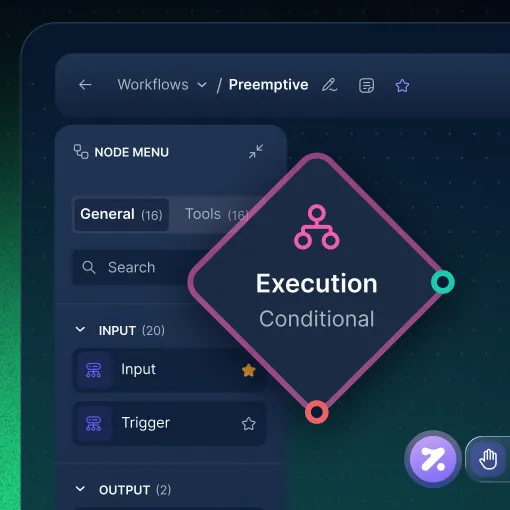
- Workflows are built on a visual canvas with 75 tool nodes, so offensive, defensive and intelligence work runs in one place.
- NINA answers questions about an environment, a threat actor, a leaked credential or a suspicious file, and returns an answer with cited sources alongside a workflow that acts on it, with every step visible.
- Every action is governed, which means traceable, auditable, and reversible at the speed it was taken.
Zynap has coined MTRER, Mean Time to Reduce Exploitable Risk, a metric to measure the time an exposure stays usable by an attacker, and while it isn’t an industry standard it’s the number the platform is built to bring down. The clock starts when an exposure is validated and stops when the risk is gone, and it counts compensating mitigation as well as patching, because a change window can be a month away and some legacy and OT systems won’t take the update at all.
“Every other company on this list sells something that plugs in. We sell the thing that decides. And because it decides across the stack you already own, you do not have to replace anything to find out whether it works. The hand-off from break-in to the operator who monetizes it is now twenty-two seconds. That is this year’s problem, not 2029’s.”
Daniel Solís, Founder and CEO, Zynap
Gartner describes current offerings across the category as nascent. Zynap’s inclusion follows a year in which the company achieved SOC 2 Type 2 in June and ISO/IEC 27001:2022 certification of its information security management system by Prescient Security in August, and continued to expand across Europe and Latin America.
About Zynap
Zynap is the preemptive security automation platform for MSSPs and enterprise security teams. It augments the stack a team already owns, unifying threat intelligence, exposure management, offensive validation and governed remediation into one operational layer, and turning intelligence and live context into coordinated action that reduces exploitable risk before it becomes an incident. Zynap is vendor and LLM agnostic and requires no rip and replace.
Founded in Barcelona in 2024, Zynap works with MSSPs and enterprise security teams across Europe and Latin America, and is backed by Kibo Ventures and Kfund.
For more information, visit www.zynap.com