


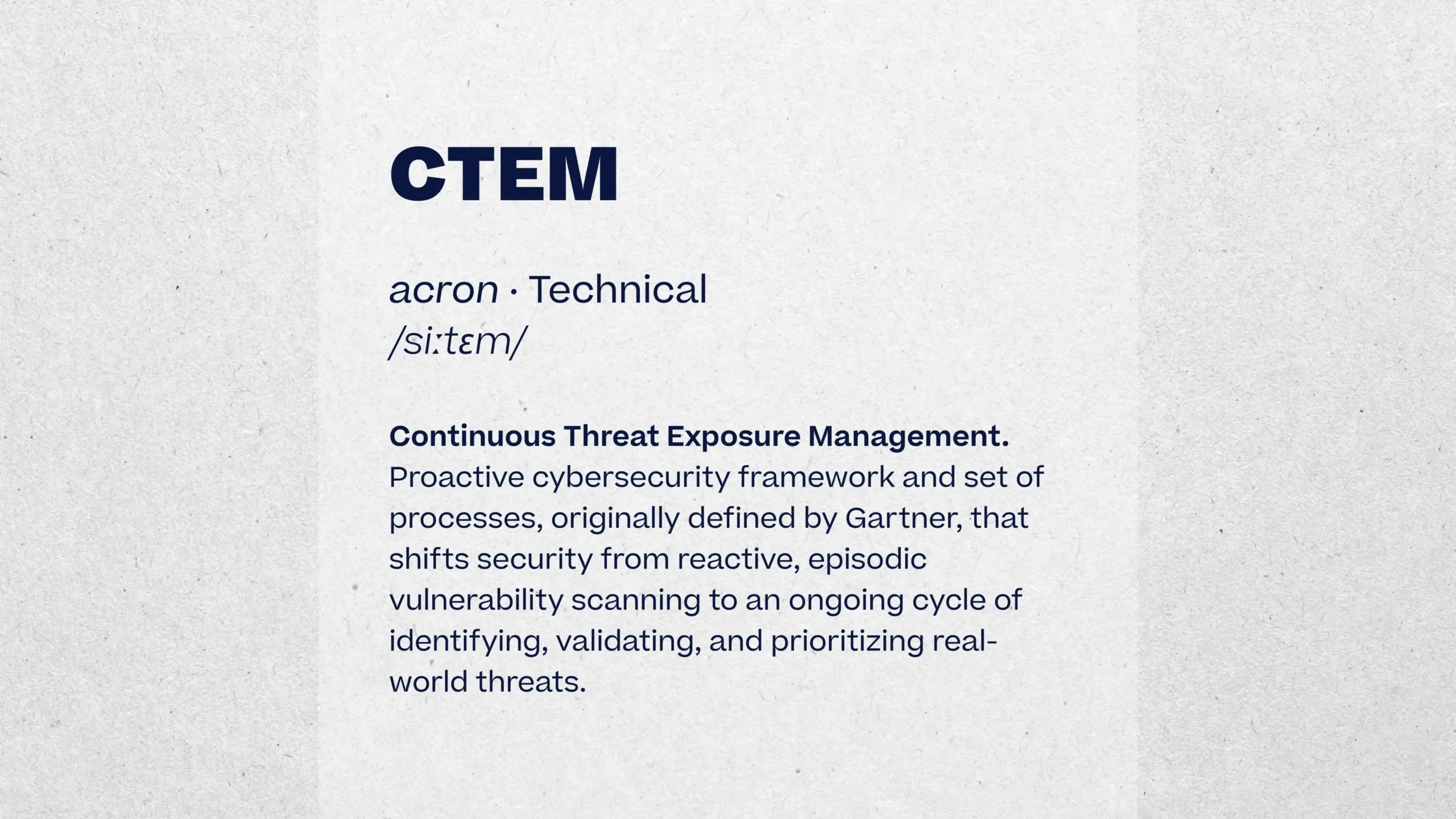
Continuous Threat Exposure Management (CTEM) is a security program for finding and fixing weaknesses before attackers can use them. Where a severity score rates each weakness by how bad it could be, CTEM looks at the risk it poses in your environment.
That means checking if an attacker could reach the weakness and use it, if attackers are already exploiting it, and which systems or data it would put at risk. With that information, you can see which weaknesses to fix first.
Gartner introduced CTEM in 2022 as a program that runs in five stages and keeps going as your systems, suppliers and threats change. It covers every kind of exposure, from an unpatched server to a leaked password or a misconfigured cloud service.
This guide is for you whether you run security for one organization or for many clients as a Managed Security Service Provider (MSSP). It walks through each stage, how to build and measure a program, and how to act on what it finds.
Key Takeaways on CTEM
- Gartner introduced CTEM as a security program for finding and fixing the weaknesses attackers are most likely to use.
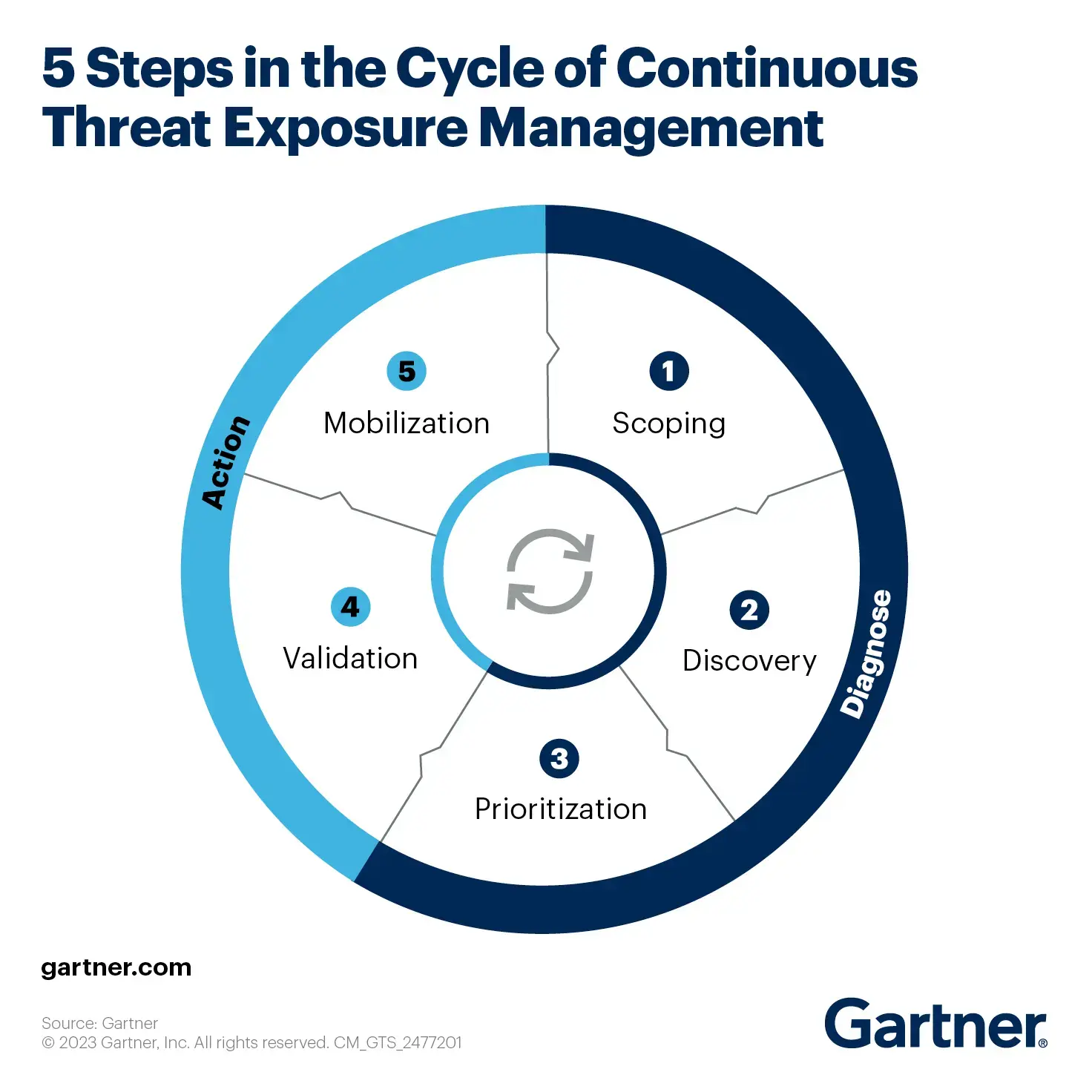
- CTEM’s five stages are scoping, discovery, prioritization, validation and mobilization.
- Traditional vulnerability management ranks weaknesses by severity, while CTEM ranks them by risk in your environment.
- Unlike a one-time scan or test, CTEM runs as a continuous cycle.
- In-house security teams run CTEM to protect their own organization.
- MSSPs can run CTEM for each client as a managed service.
What Is Continuous Threat Exposure Management (CTEM)?
Continuous Threat Exposure Management (CTEM), also called threat exposure management, is an ongoing security program for finding, testing and fixing exposures. Gartner describes it as a way to “continually and consistently evaluate the accessibility, exposure and exploitability” of an organization’s digital and physical assets.
CTEM works across the tools a security team already runs, from vulnerability scanners and attack surface management to threat intelligence and ticketing. Each cycle starts by choosing what to cover, like your internet-facing systems or one system the business depends on. Discovery maps everything in that area, and prioritization ranks what it finds by the risk it poses in your environment. Validation proves which exposures an attacker could use, and mobilization gets them fixed or blocked. Then the cycle starts again from what the last one found.
Because the work is ongoing, CTEM is a program your team runs. Tools support each stage, but no single product does CTEM for you, and that includes ours.
Why CTEM Matters
In Verizon’s 2026 Data Breach Investigations Report, exploited vulnerabilities rose to 31% of breaches, while credential abuse fell to 13%. The same report found that organizations fully fixed only 26% of the critical vulnerabilities on the US Cybersecurity and Infrastructure Security Agency (CISA) Known Exploited Vulnerabilities list in 2025. The median time to a full fix was 43 days.
CTEM gives a team four things that help close that gap.
- A list in order of real risk. The team works on the exposures an attacker could reach and use before anything else.
- An owner for every fix. The team that owns each system receives the validated exposure and the evidence behind it.
- Fewer unknown assets. Discovery finds what nobody had recorded, like an old cloud account or a supplier connection.
- A measure people can follow. Boards, auditors and an MSSP’s clients can all see from each cycle if exploitable risk went down.
The Five Stages of the CTEM Framework
The five stages of the CTEM framework are scoping, discovery, prioritization, validation and mobilization. The first three help you understand what’s exposed and what matters most. The last two prove what an attacker could use and get it fixed or blocked. Gartner’s diagram of the cycle groups the stages the same way, under Diagnose and Action.
| Stage | What happens | What it produces |
|---|---|---|
| Scoping | You choose which part of the business to cover first | An agreed list of what’s covered, with an owner for each part |
| Attack surface discovery | You find the assets in scope and the exposures they carry | A list of assets and exposures, including ones nobody had recorded |
| Vulnerability prioritization | You rank exposures by how likely an attacker is to use them and what’s at stake | A list in order of risk |
| Exposure validation | You test if an attacker could use the highest-priority exposures | Proof of what’s exploitable in your environment |
| Mobilization | The right teams fix or block what was validated | Fixes or compensating controls, with evidence they’re in place |
1. Scoping
Scoping decides which part of the organization a CTEM cycle covers first. A scope can be the internet-facing systems, the payments platform or the systems that hold customer data. It’s agreed with the people who own those systems and written down, so everyone works from the same list.
Scopes change as the business does, because a new cloud account, an acquisition or a new supplier all add things to cover. That’s why the scope is reviewed at the start of each cycle.
2. Attack Surface Discovery
Attack surface discovery finds the assets in scope and the exposures they carry. That includes the assets in your inventory and the ones that never made it there, like a forgotten subdomain or a test server left online. Discovery also covers other ways in, like leaked credentials, misconfigurations, accounts with too much access and connections to suppliers.
Finding assets is well covered by today’s tools. Gartner noted in September 2026 that discovery features have become “largely commoditized,” because nearly every security or operational platform includes some form of it. What takes more work is bringing together what each tool finds, so the same server doesn’t appear several times in different consoles.
3. Vulnerability Prioritization
Vulnerability prioritization ranks what discovery found by the risk it poses in your environment. It covers misconfigurations and leaked credentials as well as vulnerabilities. For each exposure, it asks if an attacker can reach it, if a working exploit exists and which systems or data it would put at risk.
That’s how a medium-severity flaw on an internet-facing system with public exploit code can rank above a critical one on an isolated server. A public list, like the one CISA publishes in the US, tells you if a vulnerability is already being exploited. On top of that, threat intelligence context shows which weaknesses the groups targeting your sector are using.
4. Exposure Validation
Exposure validation tests if an attacker could exploit a prioritized exposure in your environment. It accounts for the controls you already have, like firewall rules and endpoint protection. A vulnerability can be rated critical and still be blocked by one of those controls, while another can be rated minor and still sit on a path to something valuable.
Teams validate with penetration tests, red team exercises, Breach and Attack Simulation (BAS) and attack path analysis. If validation only happens at an annual penetration test, anything found in between waits months for proof. By 2028, Gartner expects more than half of enterprise exposure assessment platforms to deliver AI-driven validation natively, up from less than 10% today.
5. Mobilization
Mobilization gets validated exposures fixed or blocked. The fix can belong to IT operations, a cloud team, an application owner or a supplier. For an MSSP, it can sit with the client’s own IT team.
A fix can be a patch, a configuration change, a password reset or a compensating control that blocks the attack path until the patch is in. Changes to production systems often need approval through a change process.
CTEM vs Vulnerability Management: Key Differences
Vulnerability management and CTEM overlap, but they answer different questions. Traditional vulnerability management finds known vulnerabilities and ranks them by severity score. CTEM covers every kind of exposure, ranks each one by the risk it poses in your environment and follows it through to a fix.
| Traditional vulnerability management | CTEM | |
|---|---|---|
| How often it runs | On a schedule, like monthly or quarterly scans | Continuously |
| What it covers | Known vulnerabilities on known assets | Every exposure in scope, including unknown assets, misconfigurations and leaked credentials |
| How it ranks findings | By severity score | By risk in your environment |
| How it checks findings | Separately, through occasional penetration tests | Validation is one of its five stages |
| What it hands over | A list of vulnerabilities to patch | Validated exposures, each with an owner |
| How success is measured | Vulnerabilities patched | Exploitable risk reduced |
Handing validated work to the teams who fix it is where Gartner sees a measurable difference. By 2027, Gartner expects organizations that feed exposure data into IT and business workflows to see 30% less unplanned downtime from exploited vulnerabilities than those using isolated vulnerability management tools.
CTEM also works with the other tools a security team runs, and each one covers part of the cycle.
| Tool | What it does | Where it fits in CTEM |
|---|---|---|
| Attack Surface Management (ASM) | Finds internet-facing assets, including ones nobody had recorded | Discovery |
| Adversarial Exposure Validation (AEV) | Tests if an attacker could use an exposure, through breach and attack simulation or automated penetration testing | Validation |
| Security Information and Event Management (SIEM) | Collects and analyzes logs to detect attacks as they happen | Outside the cycle, detecting attacks that get through |
By 2029, Gartner expects 60% of organizations to have a structured exposure validation practice as part of CTEM.
How to Build a CTEM Program
Whether you’re setting up CTEM for the first time or improving a program you already run, the same five steps apply.
1. Starting With One Scope
Covering every system at once can produce more findings than a team can deal with, so a CTEM program often starts with one area. That might be the internet-facing systems, a system the business depends on or, for an MSSP, a single client.
Once that area is under control, the team moves on to the next. Before each cycle starts, the team agrees what’s in scope and how success will be measured.
2. Connecting the Tools You Already Have
Scanners, attack surface tools and threat intelligence each show part of what’s exposed.
When they’re connected to each other and to the ticketing tools teams use for fixes, they turn findings into work someone can act on. None of these tools needs replacing to run CTEM.
3. Naming an Owner for Every Fix
The teams that patch servers, change cloud settings or update applications are often outside security.
When each type of fix has an agreed owner and a deadline for each level of risk, validated exposures don’t wait for someone to claim them. For an MSSP, that agreement also covers which fixes the MSSP makes and which stay with the client’s team.
4. Planning for Exposures You Can’t Patch Yet
Some systems can’t be patched straight away. The vendor may not have released a fix, the system may be too old to update, or the next approved change window may be weeks away.
In the meantime, a compensating control can stop attackers from reaching the weakness. A firewall rule that blocks access to the system is one example. When these measures are agreed in advance, they can be put in place as soon as they’re needed.
5. Validating Continuously
Testing exposures as they’re found, and testing fixes again once they’re in, keeps the results current. Automated testing, like breach and attack simulation, makes that possible between penetration tests.
Each retest confirms if a fix worked, and over time the results show how much risk has gone down.
How to Measure If CTEM Is Working
Once your CTEM program is running, the next step is measuring if it’s reducing risk.
Activity Metrics vs Outcome Metrics
Activity metrics count the work a program does, like findings logged, tickets raised and patches applied. They show how much was done, though they don’t show if the organization is safer.
Outcome metrics measure the result. They track how much exploitable risk has gone down and how long that took. Gartner expects buyers of exposure management tools to judge them more and more on measurable risk reduction.
What Is MTRER?
Mean Time to Reduce Exploitable Risk (MTRER) is a metric we’ve coined for measuring that outcome. It tracks the average time an exposure stays usable by an attacker, from the moment it can be reached to the moment it can no longer be used.
Mean Time to Respond (MTTR) starts when an incident is detected. MTRER starts earlier, while the exposure is still open, so it counts the time before anyone notices the exposure as well as the time it takes to fix. It also works whether the fix is a patch or a compensating control that blocks the attack path.
| MTTR | MTRER | |
|---|---|---|
| What it measures | How long it takes to respond to an incident | How long an exposure stays usable by an attacker |
| When the clock starts | When an incident is detected | When the exposure can be reached |
| When the clock stops | When the incident is contained | When the exposure can no longer be used |
| What it shows | How fast the team reacts | How fast exploitable risk comes down |
CTEM for MSSPs
If you’re an MSSP, CTEM gives you a way to deliver exposure management to each client as an ongoing service.
Running CTEM Across Client Environments
Every client comes with its own systems, its own contract and its own view of how much risk it can accept. That’s why each one gets a separate scope, and its findings stay apart from every other client’s.
How urgent an exposure is also depends on the client, because each business relies on different systems. So when a newly exploited vulnerability is announced, the team can see which clients it affects and where it ranks for each one.
Growing Service Capacity
Triaging scan results by hand takes time, and that time grows with every client an MSSP adds. With CTEM, prioritization and validation bring each client’s findings down to the exposures an attacker could use, so analysts begin with the ones that matter most.
Because the same five stages and shared workflows apply to every client, nothing needs rebuilding when a new one joins. The team can take on more clients and keep the same standard of work for all of them.
Offering CTEM as a Service
A CTEM service builds on a regular vulnerability report. Each client gets a defined scope and a cycle that keeps running, and every validated exposure goes to the people who can fix it.
It also gives the service agreement something new to measure. Detection and response agreements are built around how quickly an attack is detected and contained. A CTEM service can add a commitment on how quickly exploitable risk goes down. MTRER measures that outcome, so it can sit alongside response times in the agreement.
For clients, the results of each cycle are evidence they can take to their own board or auditors. Gartner’s Market Guide for Adversarial Exposure Validation names managed service providers and validation tools as the two main ways organizations will add exposure validation to their CTEM programs.
CTEM for Enterprise Security Teams
In-house security teams can also use CTEM results to report to the board and to show regulators how they manage risk.
Reporting Cyber Risk to the Board
Cyber risk has become a regular topic for boards, and Gartner’s Top Trends in Cybersecurity for 2026 reports that 93% of directors see it as a threat to shareholder value. That’s where outcome metrics help most, because they show the board if exploitable risk is going down.
CTEM can also show that risk in terms the board already uses. When a scope is built around a business service, like online payments or a customer portal, each cycle shows how much exploitable risk went down in that service. Over a few quarters, the results become a trend the board can follow.
Evidence for NIS2, DORA and Other Regulations
Neither the EU’s NIS2 Directive nor its Digital Operational Resilience Act (DORA) mentions CTEM by name. Both expect regulated organizations to manage cyber risk and to be able to prove it. NIS2 lists vulnerability handling among its required security measures, and DORA requires regular resilience testing that includes vulnerability assessments.
A CTEM program produces much of that evidence as it runs. Each cycle records what was in scope, what was found, what was validated and what was fixed or blocked. The same records help outside the EU too. Chile’s Cybersecurity Framework Law (Ley 21.663), for example, asks operators of vital importance to run a continuous security management system and keep a record of what it does. Our guides to NIS2 and DORA, and Ley 21.663 cover each one in more detail.
Preemptive Exposure Management: Acting on What CTEM Finds
Once your CTEM program finds and ranks exposures well, the next step is acting on them. Risk only goes down when an exposure is fixed or its attack path is blocked, and that’s where Gartner’s latest research puts the focus.
Where Gartner Places CTEM
Exposure management has grown in stages. The first was vulnerability assessment, built to find weaknesses and score them. The second, exposure assessment, looked across more of the attack surface and added the context needed to rank what it found.
CTEM belongs on the proactive side of security, together with patching and configuration changes. That work cuts the number of ways an attacker can get in and limits the damage if one does. CTEM makes it continuous and focused, so the team’s time goes to the exposures that matter most to the business. Each cycle proves which of those an attacker could use and hands them to the people who can fix them.
Gartner’s latest research supports this view. Its report Emerging Tech: Top Use Cases Driving Preemptive Cybersecurity Growth (September 2026) uses CTEM as the example of “continuous, automated exposure validation and mobilization.” The Emerging Tech Impact Radar™: Preemptive Cybersecurity, published the same month, says CTEM programs are already past the early-adopter stage. Many teams have this foundation in place.
What Preemptive Exposure Management Adds
Preemptive security builds on that foundation and takes it further. Gartner calls this next phase Preemptive Exposure Management (PEM), and its September 2026 report on agentic security defines it by what happens after an exposure is found. First, the exposure is tested to see if it could be part of a real attack path. Then targeted controls disrupt that path while the permanent fix is on its way.
“PEM represents a strategic evolution, shifting the focus from exposure visibility and prioritization to accelerated, action-oriented execution of continuous threat exposure management.”
Gartner, Agentic Security: Preemptive Exposure Management Demands AI-Driven Validation and Autonomous Interdiction, p.6
That covers the time between proving a risk is real and finishing the fix. It’s the same gap behind the Verizon figures earlier in this guide. If the patch for a vulnerable VPN appliance has to wait for the next change window, a temporary firewall rule can block the attack path until it’s installed.
By 2028, Gartner expects at least 30% of security platforms with exposure management capabilities to block attack paths like this, up from less than 5% today. Early adopters are mostly in healthcare and finance, and wider adoption is expected within one to three years. We explain the approach in more depth in our guide to preemptive exposure management.
How to Choose a Platform for CTEM: 6 Questions to Ask
When you evaluate a platform for CTEM, these six questions follow the program stage by stage. They show how much of the program the platform can support and where other tools or people will still be needed.
| Question to ask | What a strong answer looks like |
|---|---|
| Can you choose which part of the business each cycle covers? | You can choose a business service, a group of systems or, for an MSSP, a single client, and change the scope as the business changes. |
| Does the platform find assets that aren’t in your inventory? | It finds unknown assets, leaked credentials and misconfigurations, and it combines what your existing tools find so each asset appears once. |
| How does the platform decide which exposures to fix first? | It ranks exposures by the risk they pose in your environment. That means checking if an attacker can reach each one, if it’s already being exploited and which systems or data it puts at risk. |
| Does the platform test which exposures an attacker could use? | It tests the highest-priority exposures against the controls you already have, and it can do that between penetration tests. |
| Does the platform only recommend fixes, or can it reduce the risk? | It sends each validated exposure to its owner with the evidence, can block the attack path while a fix waits, and tests again to confirm the risk is gone. |
| How does the platform measure results? | It shows how much exploitable risk has gone down and how long that took, alongside the work done. |
The fifth question is where platforms differ most. Gartner notes that risk-based ranking is standard in most exposure assessment platforms, while the ability to act on exposures is still rare.
How Zynap Supports CTEM and Goes Further
We built Zynap as a preemptive security automation platform for MSSPs and in-house security teams. The platform brings threat intelligence, exposure management, offensive validation and remediation together on top of the tools a team already runs.
Zynap isn’t a CTEM platform, but it does support every stage of a CTEM program. It then goes further by acting on validated exposures before they turn into incidents. In September 2026, Gartner® named us a Sample Vendor for Autonomous Cyber Defense System (ACDS) in its Emerging Tech Impact Radar™: Preemptive Cybersecurity.
Where Zynap Fits in a CTEM Program
Zynap plays a part at each of the five stages, and your team stays in charge of the program.
| CTEM stage | How Zynap supports it |
|---|---|
| Scoping | You set the assets in scope, like domains and IP addresses, for your organization or for each client. |
| Discovery | Attack surface management maps internet-facing assets and services every day, and credential monitoring finds leaked or stolen passwords linked to your domains. |
| Prioritization | Threat intelligence ranks vulnerabilities by known exploitation, exploit probability and severity, and links the top ones to the threat actors associated with them. |
| Validation | Offensive workflows test if an attacker could use an exposure, and leaked credentials are checked to see if they still work. |
| Mobilization | Workflows send each validated exposure and its evidence to the team that owns the fix. |
That’s how a large European retail bank already runs its CTEM program with us, and Gartner shared the story in Emerging Tech: Top Use Cases Driving Preemptive Cybersecurity Growth.
How Zynap Takes CTEM Further
Gartner’s cycle groups validation and mobilization under Action. Inside Zynap, NINA, our multi-agent engine, takes the ranked list from prioritization and tests the exposures on it the way an attacker would. NINA then brings every tested finding into one place and routes each one to the team responsible for the fix.
Either a fix or a blocked attack path brings risk down, and Zynap helps with both. While a fix waits for a patch or a change window, workflows can block the attack path with the EDR, firewall or identity tools you already run. Validation can then run again to confirm the exposure can no longer be used. You decide which of these actions run on their own and which wait for your team’s approval.
Whether you’re setting up your first CTEM program or improving one you already run, the next cycle can start with a single scope, like your internet-facing systems. If you’d like to see how that cycle would work on your own stack, we’re happy to show you.