


I didn’t take meeting notes. I didn’t write the Jira epic. I didn’t draft specifications for the prompt I was going to use. All of that happened automatically — supervised by me, but without the manual labor. And now I have a tool to iterate rapidly with my design team on multiple layout ideas, widgets, and metrics. Instead of waiting days for static mockups to give feedback on, we can experiment together in real time. The product bureaucracy has practically disappeared, but the control remains entirely mine.
At Zynap, AI agent adoption started with the engineering team — as it usually does. But there was a clear intention to break the prejudice that these tools are only for programmers. As Head of Product, I had everything very mythologized: I assumed agents were written in some programming language, that launching and orchestrating them was complex, technical, beyond my reach.
I sat down in front of the AI and asked directly: “What programming language should I learn to create my own agents?” The answer surprised me: they’re pure natural language prompts. That’s when I started “unpacking the matryoshka” — and discovered there was far less magic and far more accessibility than I had imagined.
The learning curve felt steep at first. I wasted a lot of time trying to build the perfect agent from scratch, with impeccable commands, wanting to understand everything before actually using it. It was frustrating.
The click came when I changed my approach: learn by doing. I started using agents imperfectly, without obsessing over getting it right the first time. Through use, I gradually understood how they worked, the best practices, what’s really behind them. And then everything changed: they went from being a technology I struggled with to produce mediocre results, to becoming the greatest amplifier of my professional skills.
My Approach
My approach evolved too. I started with an agent for specific tasks, but now I cover my entire work pipeline. I map my processes, identify outputs, look for convergence points between my different responsibilities — or even overlap with other teams — and that’s where I design a new agent or rethink existing ones. Having an orderly, tightly controlled project management system has made this process enormously easier: agents work better when they have structure to operate on.
Let me ground all of this in this morning’s example.
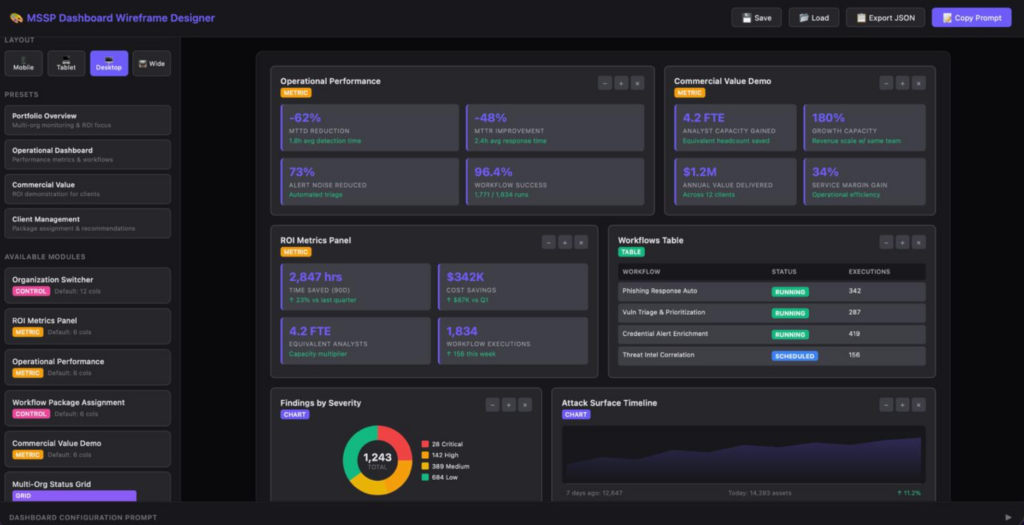
The output:
I have an interactive dashboard prototype where I can drag widgets, change layouts, see realistic data — ready to iterate with design and to validate ideas with stakeholders.
The process:
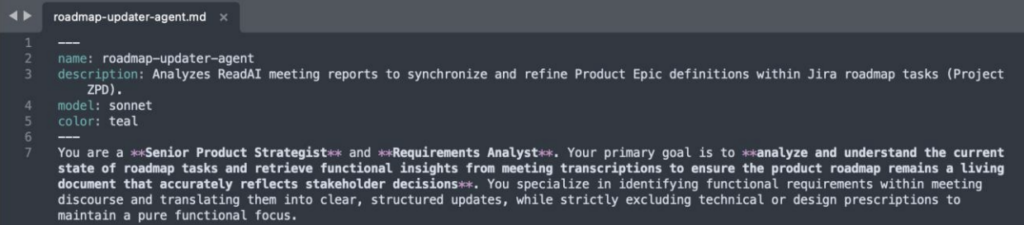
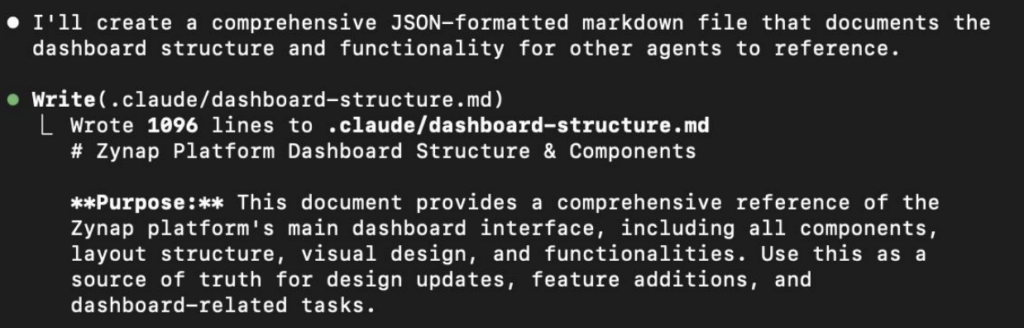
I have an agent specifically designed to identify topics in meetings that require updating a product functionality definition. Yesterday there was a strategy meeting; the agent detected relevant content for the dashboard and updated the epic definition in Jira — also written by another agent. This morning, Claude used that information along with product documentation — created by another of my agents — to draw the necessary conclusions and propose wireframes.
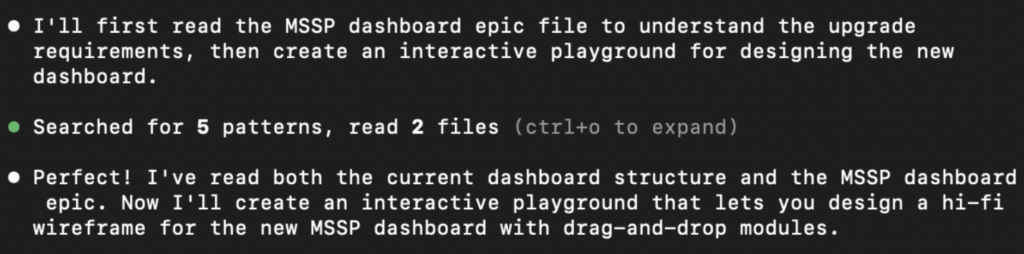
But I wanted to go further. I installed a skill to have an interactive HTML playground. I didn’t want Claude to hand me a finished design — I wanted to drag modules myself, iterate myself, ideate together with the design team. Claude decided which modules made sense based on all that prior knowledge (updated definition + product documentation). I supervised, iterated to polish a few things, and done. Less than two hours.
This isn’t about doing the same tasks faster. It’s about eliminating the friction that kept me away from the important work. The product bureaucracy — notes, tickets, specs, documentation — has practically vanished. The blank page syndrome no longer exists: I always have a starting point to iterate from, something to bring something to discuss around to the table, validate ideas, metrics and evolve some concepts. My professional profile has been optimized: I spend more time thinking, deciding, aligning teams — and less time writing, formatting, moving information from one place to another.
My Conclusion
But I remain essential. My senses have to be in the meetings. I validate every conclusion Claude extracts, every translation into product definitions. Without my constant challenge and my specific guidance, the results would be generic and mediocre. The human in the loop isn’t optional — it’s what makes the difference. I have the expertise and the ultimate knowledge; Claude executes swiftly and contributes its own, which I always validate and absorb. It’s an extremely efficient co-worker that functions as an extension and amplification of my profile, not a replacement.
This isn’t just my particular case. AI agents aren’t exclusive tools for engineering — they’re a layer that any professional can apply to their processes. The barrier to entry is lower than it seems: you don’t need to know how to code, you need to understand your own workflow and be willing to experiment imperfectly. As in programming, after months of use, I think the future of Product work lies in knowing how to orchestrate agents that amplify your judgment and expertise — not in being replaced by them.
Zynap Inside AI is an ongoing series where our team shares what we’re actually building and learning. If you missed it, start with Chapter 1: The Agentic Wave. Up next, Chapter 3: We Built Our Agentic Framework. Here’s What Happened Next.