



The problem isn’t demand. Organizations continue to outsource security operations and managed detection and response (MDR). The problem is structural: MSSP delivery models scale linearly. More customers require more analysts, and revenue growth stays locked to headcount.
According to Gartner, the average enterprise already runs 45 different security tools that “often work in silos, creating complexity, blind spots and unidentified exposures that adversaries target.”¹ For MSSPs managing dozens of such environments simultaneously, that fragmentation compounds operational drag at every level of the SOC.
In 2026, the MSSPs that scale successfully won’t just deploy faster SOAR playbooks. They’ll adopt preemptive multi-tenant automation – redesigning the operating model so that incidents never require response in the first place.
The best incident is the one that never needs a ticket.
Why Alert-Driven Automation Limits MSSP Revenue Growth
Most MSSP automation follows a reactive pattern built around alert-driven SOAR workflows:
- Security tool generates alert
- SOAR platform triggers playbook
- SOC analyst triages and investigates
- Senior analyst escalates if needed
- Response executed, ticket closed
This optimizes MTTR, but it doesn’t reduce the volume of incidents requiring human attention. The result: more customers equal more alerts equal more analysts required. MSSP growth remains linear and headcount-dependent.
Legacy SOAR platforms compound the problem in multi-tenant environments. When one customer’s alert volume spikes, SOAR playbooks queue serially, workflow backlogs grow, and SLAs across other tenants are put at risk. Reactive automation creates operational efficiency, but not operating leverage.
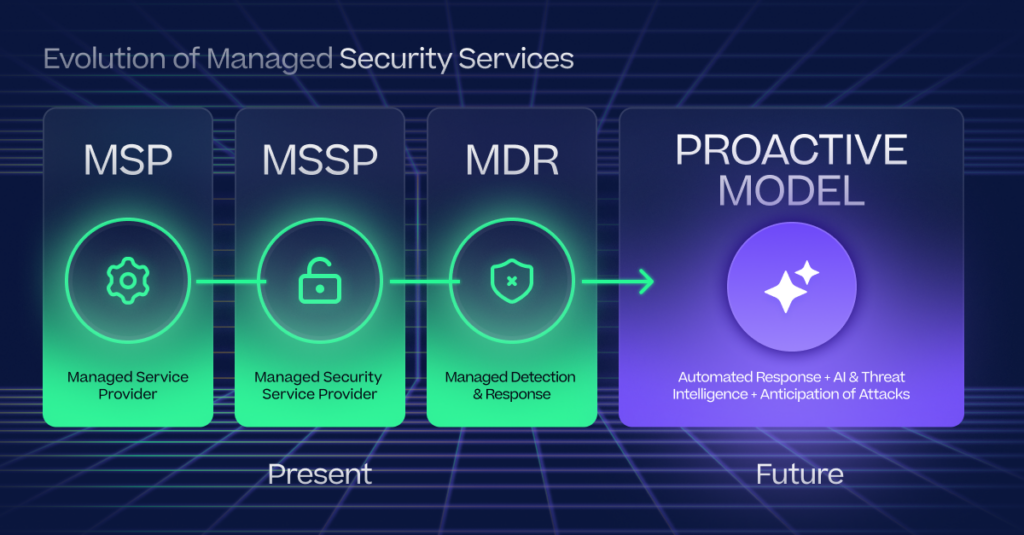
Preemptive security automation inverts this model. Instead of starting with alerts, preemptive platforms start with threat context – adversary TTPs, IOCs, asset priorities, and real-time exposure data – and act before incidents trigger detection.
Gartner captures the urgency clearly: “Attackers already use AI to target enterprises, forcing enterprises to proactively and reactively use AI for cyber defense to identify and remediate risk at machine speed and scale.”¹ For MSSPs, the old reactive model doesn’t just limit growth – it increasingly fails to protect customers at the speed modern threats demand.
The Three Levers of MSSP Scale Without Headcount
A scalable MSSP model isn’t defined by playbooks, workflows, or SOAR integrations. It’s defined by three business outcomes.
1. Revenue Elasticity
Revenue elasticity is the ability to grow MSSP revenue without proportional growth in headcount. Based on Zynap platform data, MSSPs can achieve 40-60% revenue growth without proportional headcount increases.*
This isn’t incremental MTTR optimisation. It’s a structural shift. Revenue elasticity determines whether MSSP growth compounds or simpl stretches the organisation thinner. MSSPs achieve this by reducing escalation volume, protecting senior analyst capacity, and redesigning multi-tenant service delivery so reactive noise doesn’t scale with customer count.
2. Customers Per Analyst
Customers per analyst is one of the most practical indicators of MSSP scalability. Most MSSPs are constrained by reactive SOC workload: alerts trigger investigations, investigations trigger escalations, escalations require senior analyst time.
Improving this ratio means reducing unnecessary work that ever reaches analysts in the first place. When operational noise decreases through preemptive automation, SOC analysts can manage significantly more customers while maintaining SLAs.
Doubling MDR customers per analyst without SLA degradation is achievable when the operating model eliminates reactive friction – not just accelerates it.
3. Service Multiplier
The most profitable MSSPs convert freed analyst capacity into higher-margin, differentiated service lines:
- Managed Threat Intelligence: Real-time adversary tracking, automated IOC enrichment with malware sandbox, contextualised intelligence per customer tenant
- Managed Offensive Security: Continuous adversary simulation using threat actor TTPs, automated exposure identification, proactive testing without manual red team engagements
- Premium MDR Tiers: Context-enriched escalations, automated containment with AI-assisted decision support, credentials intelligence monitoring
When senior SOC analysts are freed from repetitive alert triage, that capacity can be reinvested into new revenue. For illustrative purposes: a Managed Threat Intelligence service delivered across 60 customers could generate $120,000 in annual recurring revenue – without requiring additional headcount.*
Automation alone doesn’t create MSSP value. What matters is how freed capacity is reinvested. This is the service multiplier effect.
Preemptive vs. Reactive: The Two Approaches to MSSP Automation
| Reactive Automation (Legacy SOAR) | Preemptive Automation (Zynap) | |
|---|---|---|
| Starts with | Alerts and logs | Threat context, TTPs, IOCs |
| Logic | Alert-driven playbooks | Context-driven AI workflows |
| Action | Automates response after detection | Automates prevention before impact |
| MTTR | Optimises MTTR after failure | Reduces MTTR by avoiding incidents |
| Multi-tenancy | Resource contention under load | True tenant isolation and efficiency |
| Result | Faster reaction to a compromised situation | Many incidents never reach SOC detection |
Reactive automation optimizes failure. Preemptive automation avoids it.
How Preemptive Security Creates MSSP Operating Leverage
Zynap is the multi-tenant preemptive security platform built specifically for MSSPs that need to scale managed security services without scaling headcount.
True multi-tenant architecture. Per-tenant workflows, playbooks, and policies operate independently while shared logic templates enable rapid deployment. When a new threat campaign emerges, one multi-tenant playbook template deploys across all managed environments in hours – not weeks of custom SOAR integration per customer.
AI-driven workflow automation. Security engineers describe logic in natural language; AI agents generate, test, and maintain the automation. Based on Zynap platform data, new customers onboard up to 50% faster because workflows and playbooks are productized, not bespoke integration projects.*
Preemptive threat intelligence. Zynap continuously monitors real-time threat intelligence across all tenants and automatically correlates adversary TTPs, IOCs, and active campaigns with each customer’s exposure profile. When a new CVE is published, Zynap identifies which customers are exposed across the multi-tenant platform, assesses compensating controls, and routes preventive actions – patching, isolation, credential resets – before exploitation occurs.
Integration flexibility. Platform integrations include credentials intelligence to identify compromised accounts before use, malware sandbox for rapid IOC analysis, offensive simulation driven by adversary TTPs, and both API and non-API integration capabilities for heterogeneous customer environments.
Gartner confirms that the winning approach in next-generation cyber defence will integrate “proactive/preemptive exposure management and reactive threat detection/response in an intelligent cyber defence system.”¹ Zynap delivers this for the MSSP operating model.
The result: Based on Zynap platform data, MSSPs can achieve up to 80% reduction in MTTR, 30% reduction in FTE dependency, and 20–35% operating margin improvement per MDR customer – while maintaining service quality and SLAs as the customer base grows.*
Sofistic Cybersecurity Scales MDR with Preemptive Security
The Preemptive Security Playbook: Key Takeaways
MSSPs that scale revenue without staff augmentation share a common operating model:
1. Reject reactive efficiency.
Alert-driven SOAR platforms optimise MTTR after incidents occur. Preemptive multi-tenant automation eliminates incidents before detection – reducing the work that ever reaches the SOC.
2. Adopt true multi-tenant architecture.
Deploy playbooks, workflows, and threat intelligence once. Apply across all customer tenants instantly. Eliminate per-customer configuration overhead that kills MSSP margins.
3. Optimise the Three Levers.
Revenue Elasticity, Customers per Analyst, and Service Multiplier determine whether MSSP growth compounds or simply stretches the organization thinner.
4. Deploy AI agents for Tier 1 and Tier 2 automation.
Automate investigations without human-in-the-loop bottlenecks. Free senior SOC analysts from repetitive alert triage so they can focus on high-value work.
5. Launch high-margin service lines.
Use freed capacity to build Managed Threat Intelligence, Managed Offensive Security, and Premium MDR tiers. Automation alone doesn’t create value – what you do with freed capacity does.
MSSP Multiplier Metrics (based on Zynap customer deployment data)
- Up to 40–60% revenue growth without proportional headcount
- Up to 2× MDR customers per analyst with maintained SLAs
- Up to 80% reduction in MTTR
- Up to 50% faster multi-tenant customer onboarding
- Up to 30% reduction in FTE dependency
- Up to 20–35% operating margin improvement per MDR customer
- Up to 40–70% reduction in irrelevant detections
- Up to 20–40% fewer incidents requiring escalation
Scale Your MSSP with Zynap
Zynap is the only multi-tenant preemptive security platform built specifically for MSSP scale. Deploy AI agents, threat intelligence workflows, offensive security automation, and low-code playbooks across all customer environments simultaneously – without growing headcount.
Explore the MSSP solution or book a demo to see the preemptive security playbook in action.
Sources
¹ Gartner, “Tech FutureSight: Protect the Global Attack Surface With an Autonomous Cyber Defense System,” Neil MacDonald, 12 December 2025, ID G00844759. Gartner does not endorse any vendor, product or service depicted in its research publications and does not advise technology users to select only those vendors with the highest ratings or other designation. Gartner research publications consist of the opinions of Gartner’s research organisation and should not be construed as statements of fact.
* Based on Zynap customer deployment data.