Product
Platform
Products
More
Resources
Company
Product
Platform
Products
More
Resources
Company
Product
Platform
Products
More
Resources
Company

Real-time financial sector threat intelligence and actor tracking

AI-powered transaction monitoring and anomaly detection

Automated response for financial fraud and attack detection

Monitor compromised financial credentials and dark web activity
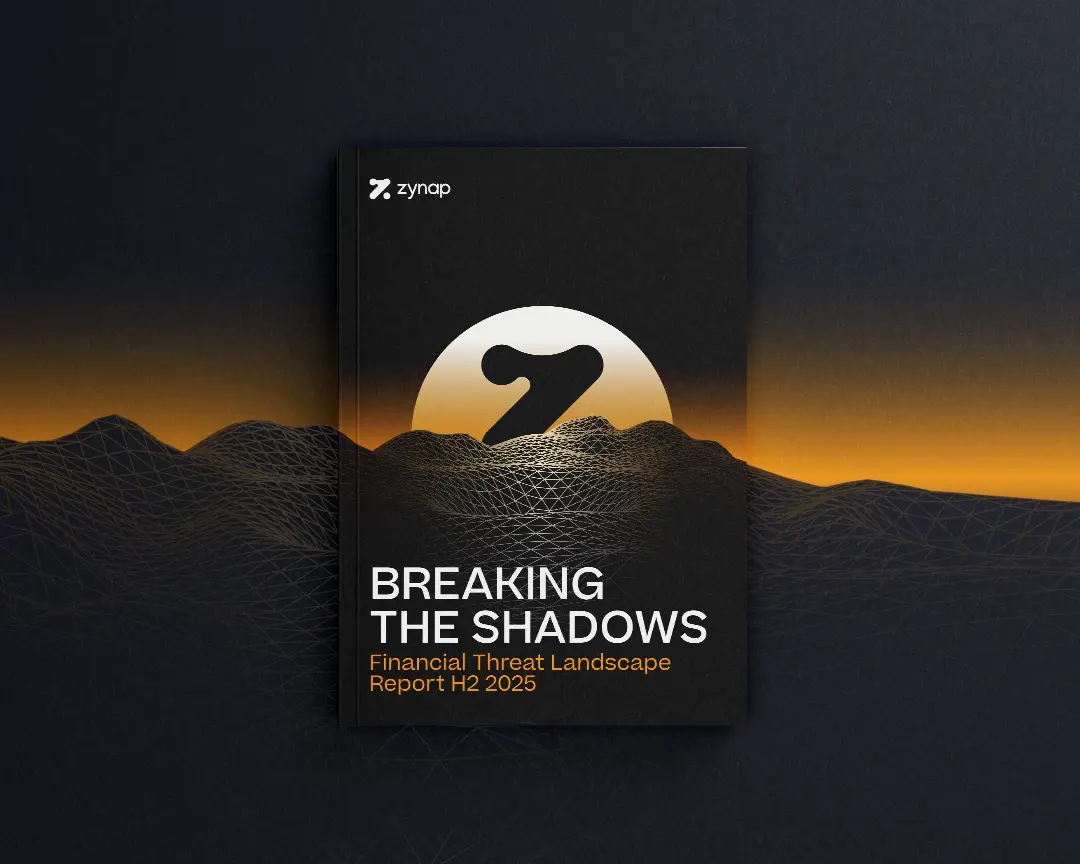
H2 2025 confirmed what the threat data has been pointing toward for years: financial services is not just a high-value target — it is a structurally exposed sector where a single compromised vendor can cascade into 80 credit unions overnight, and three crypto heists by one group can account for nearly half of all non-ransomware sector impact.
Download the full report now!
A single SonicWall exploit in Marquis Software gave Akira a foothold that cascaded across roughly 80 credit unions. Supply-chain and third-party compromise became the period's defining intrusion model. Understand what genuine attack surface control looks like when the threat enters through a trusted relationship.
Ransomware groups account for roughly 98% of recorded incidents. State-linked actors account for less than 2%. Yet Lazarus Group alone was responsible for US$58M in losses across three operations. Learn how to normalize for impact rather than count and why these two threat clusters demand entirely different defense strategies.
Seoul Guarantee Insurance: 13.2TB exfiltrated. Creditinfo: 2.3TB. Marlborough Partners: 2TB. For regulated financial institutions, terabyte-scale exfiltration means client exposure, supervisory scrutiny, and erosion of institutional trust, not just downtime. See what the sector's ransomware data actually means for your compliance posture.
The US absorbs the largest ransomware share (40.9% of victims), but H2's most significant geographic story is South Korea. Elevated to second place globally after Qilin's coordinated blitz against at least eight Korean asset managers in a single September campaign. Get the full regional picture across Americas, Asia-Pacific, Europe, and the Middle East.
Banking trojans now run entirely in memory, weaponize messaging platforms for delivery, and tunnel command-and-control through legitimate protocols. Mobile fraud toolkits are sold as subscriptions. Understand the sector's shift toward operational durability and what it demands from behavioral detection and hunting strategy.
Zynap's proprietary prediction engine ranks the highest-confidence forward risks for the sector, from supply-chain-delivered destructive attacks against financial infrastructure to escalating DDoS campaigns against NATO-nation banks. Know where to focus before the next cycle begins.
Analysis of 370 incidents spanning banks, credit unions, insurers, asset managers, crypto exchanges, and payment infrastructure. Maps the period's sectoral and geographic exposure across the Americas, Asia-Pacific, Europe, and the Middle East, anchored to a detailed timeline of H2's most consequential individual events.
Deep dives into the groups that defined H2: Qilin, Akira, and INC Ransom driving ransomware volume; Lazarus Group, ShinyHunters, and Predatory Sparrow executing the period's most consequential operations. Covers how these two clusters operate differently and why a single defense posture cannot adequately address both.
From banking trojans that weaponize WhatsApp and execute entirely in memory, to MaaS-driven mobile fraud toolkits enabling overlay and screen-manipulation attacks at scale. Covers Astaroth, SORVEPOTEL, Albiriox, PromptSpy, GRIMBOLT, Maverick, and more, with defense implications mapped to each.
186 victims, 42 groups, and a Q3 spike that peaked at 10 simultaneous financial-sector victims on a single day. Covers sub-sector targeting patterns, terabyte-scale exfiltration events, geographic concentration by country, and why the systemic consequences extend well beyond the breached institution into partner, client, and regulatory exposure.
The CVEs driving attacker focus against financial targets in H2 2025: including SonicOS, PAN-OS GlobalProtect, SAP NetWeaver, SharePoint, Cisco IOS XE, Oracle EBS, and Apache ActiveMQ. Each entry includes CVSS scores, patch status, real-world exploitation evidence, and the specific threat actors deploying them against financial sector targets.
Zynap's ranked hypothesis framework for the period ahead: a Russian state-directed destructive attack on Ukrainian financial infrastructure via supply-chain compromise and CANFAIL wiper deployment, escalating DDoS campaigns against NATO-nation banks, and criminal adaptation of state malware for financial extortion. Includes an illustrative kill chain and strategic implications across technical, business, and geopolitical dimensions.